
Social Care Hubs: A three-part approach to sustainability
by Rebecca Gerr, Senior Director
Issue in Brief
Social care hubs have a unique coordinating and enhancing role to play in addressing community health related social needs.
Hubs – and other social service providers financed though Medicaid 1115 waivers – need to find new financing mechanisms moving forward.
Hubs can work with potential payers to develop financing models to sustain their work beyond the end of the waiver periods.
To achieve this, hubs must:
1) Show the value of the coordinated care model, the improved access to services, and the downstream effects; 2) Identify the highest-impact version of services and service bundles.
In the past several years, a combination of federal, state, and local policy innovations have given rise to social care hubs. While hubs vary in their exact structure and terminology (networks, lead entities, and hubs are all used), they generally refer to backbone structures supporting a network of community-based organizations (CBOs) assembled to deliver a range of services at scale across a defined geographic region. Most of these hubs engage providers addressing health-related social needs (HRSN) such as food and housing supports.
Today, over a decade of work to deliver quality HRSN services in a more coordinated and efficient way is at risk. Due to recent Medicaid cuts and the pending expiration of several large Medicaid 1115 waivers, hubs are being forced to reconsider long-term financial viability as both their sustaining revenue and capacity building funds are at risk.
As backbone entities, hubs provide shared services to support the network at large – often to advance regional and/or community health goals. Core services can include:
Negotiation and centralized contract management healthcare payers,
Provision of technical assistance to participating CBOs,
Quality assurance of services, including monitoring and analysis,
Data collection and reporting, and
Distribution of capacity building funds.
These core services distinguish hubs from other HRSN service delivery models by simplifying and maximizing two key domains: access and quality.
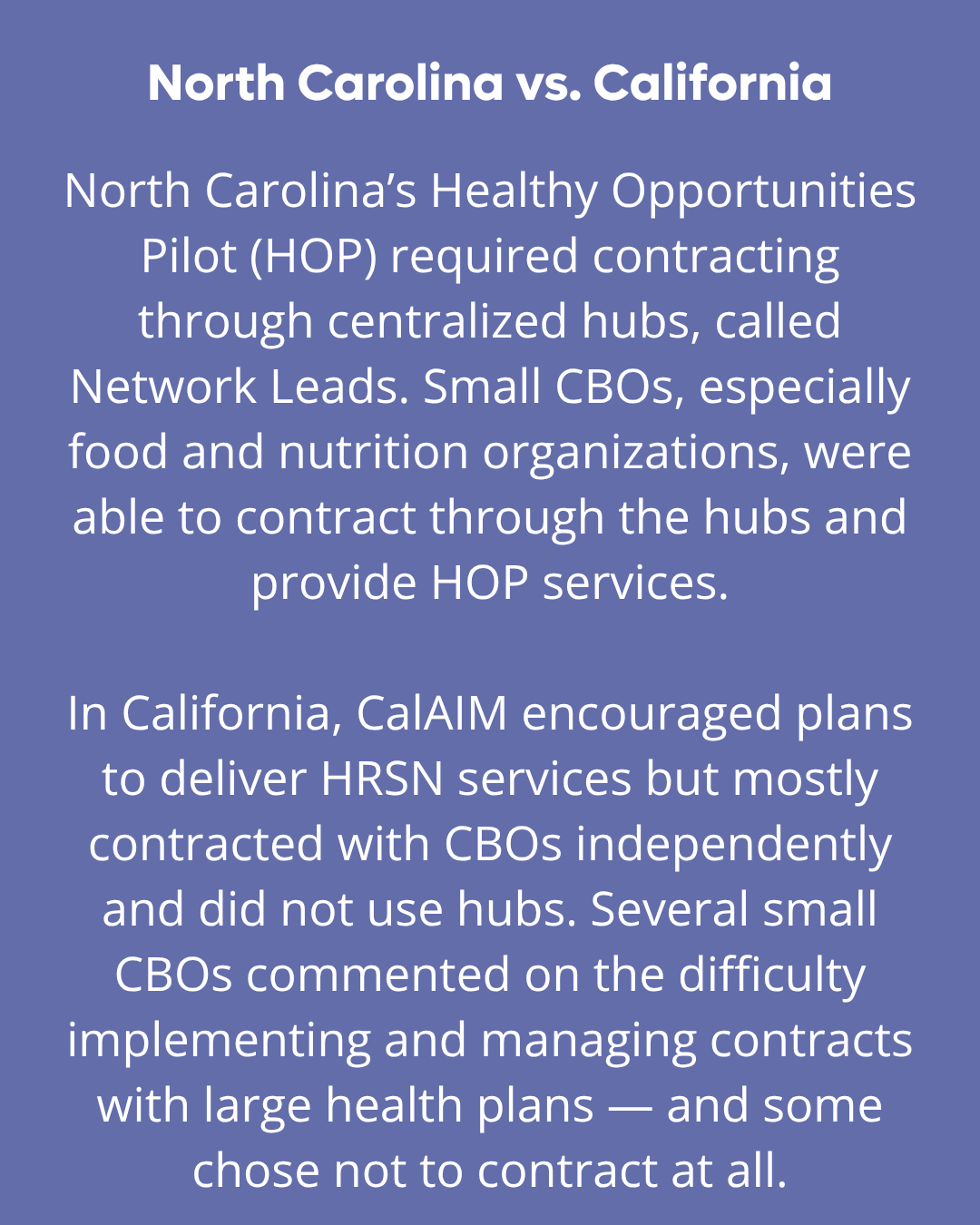
Access: Hubs hold one central contract between each healthcare payer and the hub – and one contract between the hub and each CBO. Through these dual contracts, the payer gets access to a network of trusted, vetted CBOs and the CBOs get access to a large population of clients and predictable reimbursement. Centralized contracting is particularly important for smaller CBOs that could not independently adhere to the requirements stipulated by health plans. These contracts facilitate payers’ broader access to (often) hyper-local, small CBOs that have gained the trust of members they otherwise would not be able to reach and serve.
Quality: Hubs vet potential partners and maintain robust quality standards and support for both service delivery and contract requirements (e.g. privacy, reporting, etc.). CBOs benefit from the streamlined reporting and technical assistance provided, and payers benefit from having vetted organizations delivering services for members.
While hubs are unique in their efforts to standardize HRSN service delivery and coordinate across community providers within a defined geography, the new sustainability predicament in which they find themselves is not. Unfortunately, the experience of losing essential funding (e.g., grant) or earned revenue (e.g., service billing) is all too common – particularly for CBOs delivering human and social service. These are issues that QVHS and its partners have been working to address for years.
Now that the Centers for Medicare & Medicaid Services (CMS) has rescinded guidance supporting the inclusion of HRSN services in waivers and changed the standards for both state-share of Medicaid payments and budget neutrality, CMS is unlikely to approve new large-scale HRSN waivers moving forward.
The TL;DR: Hubs and other social service providers currently financed exclusively or primarily though Medicaid 1115 waivers will need to find new earned revenue sources moving forward.
This is despite numerous proof points that hubs generate positive clinical, social, and economic outcomes for all parties. North Carolina, in particular, showed that their Healthy Opportunities Pilots generated an average of $164 in medical cost savings per beneficiary and increased economic investment in Western North Carolina.
Even with these demonstrations of positive impact, hubs have a complex financing task ahead of them: to systematically document and quantify the value they deliver to clients, partner CBOs, and payers – assessing what value the hub generates for each party. With that information, hubs can work with potential payers, such as Medicaid MCOs and other healthcare partners, to develop sustainable earned revenue and other funding sources to cover HRSN services no longer eligible for coverage under waiver authority.
Worth noting is that core infrastructure investments (e.g. electronic health records, referral platforms, contracting support) will also need to be addressed – either as a part of this value analysis, or with financing from other sources. While each hub and associated geography is unique, we offer a three-part approach to (re) thinking the sustainability strategy for these important regional service infrastructures.

Systematically document and quantify the value of hubs
While hubs are seen as important – to clients, partner CBOs, and local communities – little research has focused specifically on the unique value-add of the hub model (i.e., apart from the provision of enabled HRSN services). Federally required Medicaid waiver evaluations, such as the one completed in North Carolina, assess the overall impact of the waiver program on quality and cost and do not isolate the impact of the hub model. To engage potential payers in long-term contracts independent of Medicaid waivers, hubs will need to convey the value of their shared core services.
Because few hubs have systematically documented the outcomes produced or rigorously measured their value accrual to potential financing partners, new efforts will require active tracking and valuation of outputs (e.g., number of patients seen, referrals completed, services provided) and outcomes (e.g., reduced hospital readmissions, improved housing stability) generated.
Has your hub calculated the value of its centralized services and how it influences outcomes generated?
Email QVHS to discuss your findings!
As this likely will require access to external data (e.g., clinical outcomes) maintained by other healthcare organizations, some hubs are looking to proactively develop partnerships with payers. Other hubs are working directly with evaluators to formally estimate their value proposition. Hubs without access to these partnerships and resources can extrapolate from national research and apply the findings to their own network model.
Of course, each hub may focus on specific health goals and/or employ different HRSN service models, so, the exact outcomes and metrics will vary. However, the overall goal remains the same: show the value-add of the improved access to high-quality services that hubs enable.
This will also need to include the impact of any upfront infrastructure investment required to build enabling hub capacity. Investment in the backbone hub functions enables the core services – and value – that payers derive. Functions like centralized contracting, quality monitoring, and reporting ensure high-quality CBO service delivery and are only possible with funding for staff, technology, and operations. Care coordination – whether social, clinical, or both – requires further investment in staff and technology for success. Recent 1115 capacity-building funds for hubs represent a large portion of backbone funding for social services. Quantifying the impact of those funds – both in terms of clinical outcomes, and also local investment, jobs, and clients served – will help justify the need for ongoing support.

Identify and organize around the highest-impact version of services and service bundles
Most hubs find that - across partner CBOs - there is great variation in service delivery – in terms of frequency, intensity, and the population of focus. Consequently, the resulting outcomes (i.e., level of desired impact) also vary. Under the original 1115 waiver framework, hubs were often encouraged or required to contract with any organization that could meet basic operational requirements. As hubs look to attract long-term sustainable financing, they will need to ensure that partners not only meet these basic requirements but also deliver the highest impact version of an eligible service.
Hubs will need to assess the quality of service delivery across the network - looking at both the variety of models that exist, and whether there are strong models for particular subgroups. For example, a fresh produce delivery may provide excellent value for a stably housed individual, but not for someone who is housing insecure. Identifying – and standardizing – the service models, bundles, and populations that consistently produce strong, quantifiable outcomes will strengthen the overall value offering of the hub when entering into payer contract negotiations. For some hubs, the findings of this analysis may necessitate difficult conversations about the value of maintaining relationships with CBOs whose programs do not align with hub impact priorities.
Many hubs also include care coordination as part of their service delivery model, working to ensure that services are delivered in a manner that puts patients at the center and address their full range of needs. Assessing the value add of this care coordination – both as a service itself and as part of the overall hub model, may be necessary to ensure its retention in the hub model.

Sustainability solution: Contract based on value
With these analyses in hand, hubs can make strategic decisions about what they will deliver, with which partners, and for whom. They can then engage potential payers to further refine the population of focus and service model to ensure that goals are aligned.
For most hubs, a long-term sustainable financing plan will require a multi-payment type and multi-payer strategy. While most hubs start with fee-for-service (FFS) Medicaid billing opportunities that align with their current offerings, modeling often shows that FFS reimbursement on its own does not fully cover the costs of delivering coordinated services through the hub model – and certainly does not adequately compensate hubs for the value produced. As such, hubs that start by implementing FFS billing for in lieu of services (ILOS) for HRSN services, community health worker billing, or care coordination will also need to explore alternative payment models (APM) that tie a portion of payment to value generated.
For hubs, implementing APMs such as bundled payments or outcomes-based payments offers a path to sustainability and rewards them for the very services they are designed to provide: ensuring high quality and attracting a wide range of CBOs trusted by the local community.
Sustaining the impact of hubs on clients and communities is critical now, more than ever before. Funding cuts to Medicaid, SNAP, and other programs have severely limited the services available to many individuals. By providing members with access to high-quality services, payers with access to a network of CBOs that provide consistent quality services, and CBOs with a predictable revenue stream and services to support their high impact work – hubs can continue to serve their regions for decades to come.
